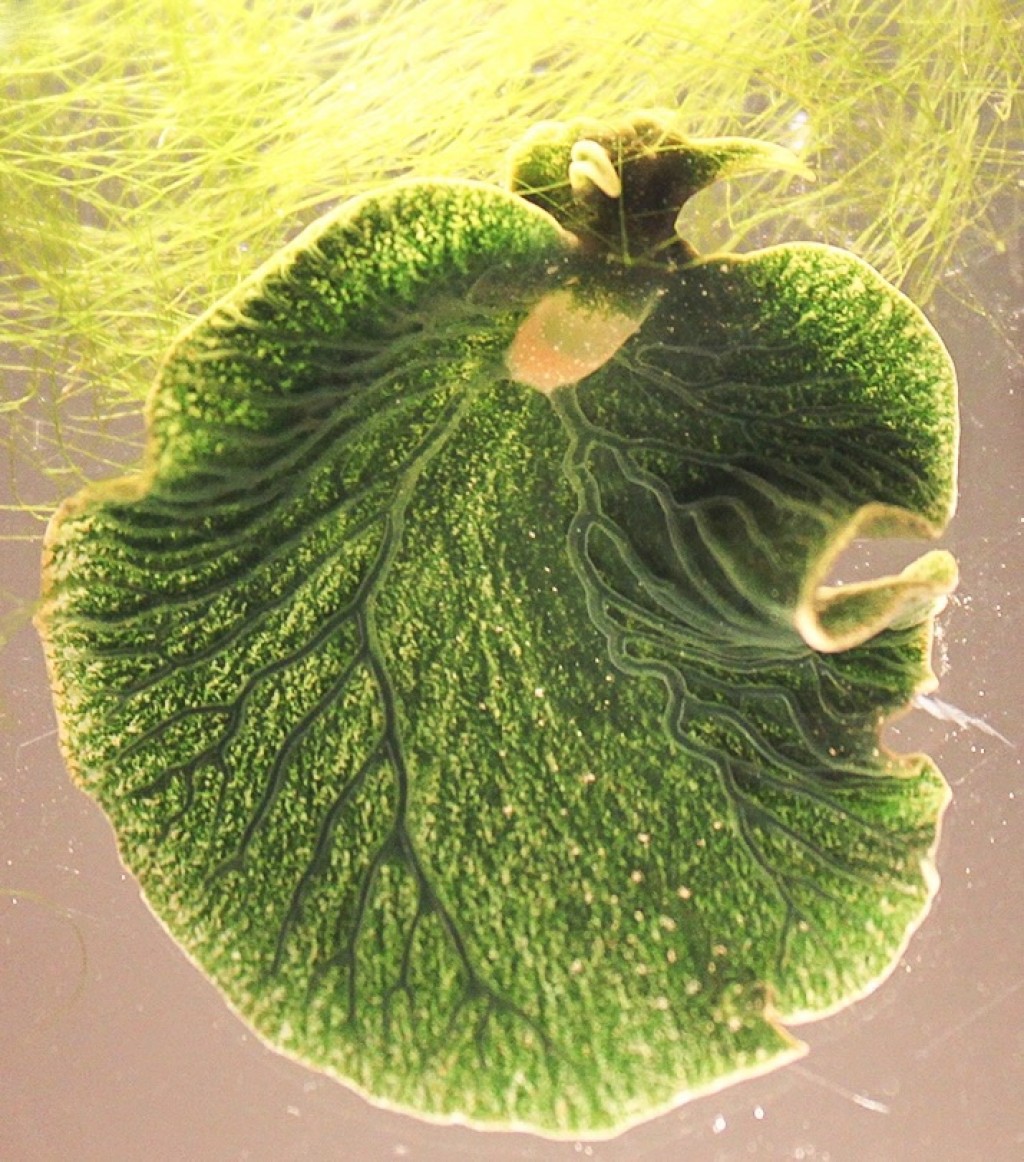
There is a sea slug called Elysia chlorotica that lives off the East Coast of the US and looks like an unassuming green leaf. It feeds on algae and instead of digesting them entirely it steals the chloroplasts, the parts that do photosynthesis in plants, and stores them in its own cells. A phenomenon that is called kleptoplasty.
The chloroplasts can keep working inside of the slug, producing sugars from sunlight and allowing the slug to go for long periods with minimal feeding. Exactly how the slug is able to keep the chloroplasts functioning for so long is not yet well understood.
But researchers are looking to it for inspiration. With the hopes of finding ways of getting photosynthesis to function outside of plants since it can generate useful chemical energy and potentially help support the management of oxidative stress.
There are a couple of big problems with that. For one, chloroplasts are not independent and normally rely on the host plant cell for repair and regulation. Secondly, mammalian cells tend to treat chloroplasts like invading foreign material and eventually break them down.
In 2024, researchers showed that mammalian cells could temporarily hold working chloroplasts despite those challenges. They introduced chloroplasts from a red algae into cultured hamster cells and were able to measure photosynthetic electron transport activity for at least two days before the chloroplasts eventually lost function.
A newer 2026 study took a more targeted approach and instead of trying to keep the whole chloroplasts alive they used a smaller part of the chloroplast called the thylakoid. Thylakoids are essentially the “solar panels” of plant cell and are where the light dependent reactions of photosynthesis happen. The appeal of thylakoids is that light can drive them to generate NADPH, a molecule that plays a key role in antioxidant systems.
One disease that centers around oxidative stress is Dry Eye Disease, where the surface of the eye can become inflamed and damaged because reactive oxygen species, unstable oxygen based molecules that can damage cells, build up faster than the tissue can neutralize them.
What they did here was engineer thylakoids from spinach into a nanoscale system they call LEAF and tested it in a dry-eye disease model by administering them via liquid eye drops. Under visible light LEAF generated NADPH and ATP and appeared to reduce oxidative stress and inflammation while protecting the surface of the eye.
The eye makes a perfect target for this type of therapy because it is already exposed to light during day to day activity. Now, there is still a lot more that needs to be done before anything like this can really be said to be both effective and safe. But it is pretty neat to see such a unique mechanism, from the animal kingdom, inspire new directions in biomedical research.